Everything Implicit Becomes Infrastructure
Why AI works so well for individuals and so poorly for teams: everything that's free when you work alone must be built when you don't. Seven rows, one law.
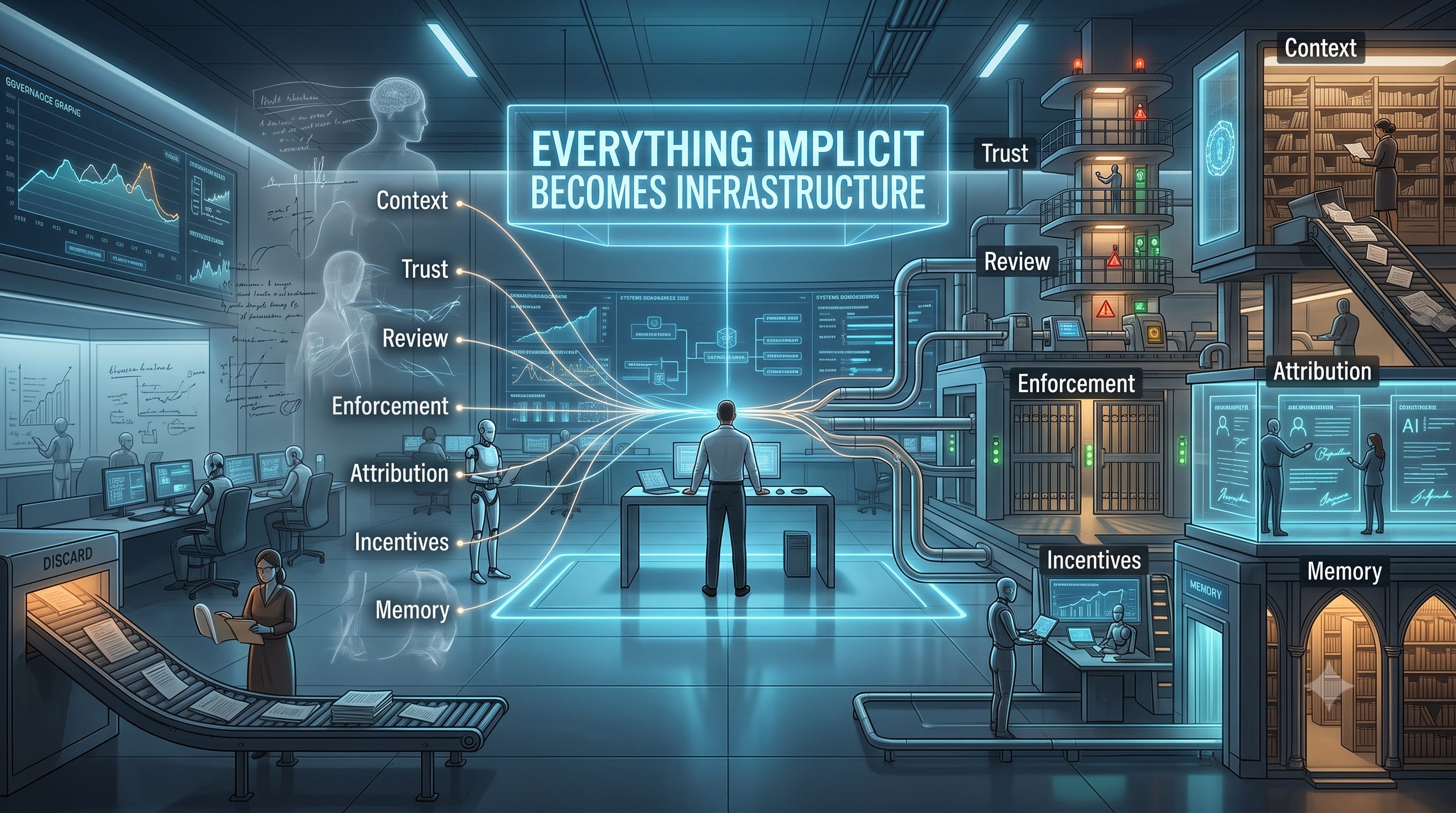
There’s a question underneath most of the conversations I have about AI, and it rarely gets asked out loud: why does this work so well for individuals and so badly for organizations?
The individual evidence is everywhere. A single developer ships what used to take a team. A solo founder runs functions that used to be departments. I’m one of the data points: my company’s engineering, marketing, and operations all run through AI, supervised by one person, and the honest description of a normal week would have sounded like fiction two years ago.
The organizational evidence is also everywhere, and it points the other way. The pilots that never reach production. The 5x tool that ships 1.3x. The enterprise AI program that produces demos, decks, and a quiet sense that something isn’t converting.
I used to think the difference was skill, or courage, or organizational sludge. I now think it’s something more mechanical, and more fixable. Everything that makes an individual productive with AI is implicit — invisible, automatic, free. An organization gets none of it for free. Every implicit thing must become infrastructure. That’s the law. The rest of this essay is just the table.
Row 1: Context
Solo, your context is unified. One head holds the whole business — the customer’s history, the codebase’s quirks, the reason the March decision went the way it did — so the AI you work with is always fed the right context, because you are the retrieval system.
A team’s context is fragmented across people, wikis, and chat threads, and AI amplifies whoever feeds it. Most “the model isn’t good enough” complaints I hear are context-supply failures wearing a model-quality costume. The infrastructure: curated knowledge assets — and curation means exclusion, not collection; the full treatment of this row is published. The solo operator’s real asset is knowing what doesn’t matter; teams that dump everything into a retrieval system discover that more context makes answers worse. Most organizations have documentation. Almost none have curation — and one free source of it gets thrown away daily: every correction a reviewer makes is a context patch waiting to be filed.
Row 2: Trust
Solo, you run an earned-autonomy ladder in your head. You know precisely which tasks your AI handles unsupervised, which get reviewed, which it never touches — and you adjust the ladder daily without noticing you’re doing it.
In a team, person A’s “the agent handles this fine” is not person B’s, and nobody’s calibration is legible to management. The infrastructure: explicit autonomy tiers keyed to something objective — I’ve argued for reversibility as the axis — plus the part almost nobody builds: promotion mechanics — this row’s full treatment is published too. An action class should earn a rung the way an employee earns one: a track record of clean runs, recorded reviews, automatic demotion on incident. You don’t hand a new hire production keys on day one; the same logic applies to a config file. A few days ago an engineer I’d never met implemented the reversibility ladder in his own incident-response agent and published the result; his sharpest finding was that the safe default has to live in code, not config, so a risky new tool can’t slip through by omitting a field. Trust policy, compiled.
Row 3: Review
Solo, producer and reviewer are the same person at different timescales, so review capacity scales with production automatically. This is the row organizations hit first and hardest: AI multiplies production while review capacity stands still, and the arithmetic caps realized throughput at whatever the person who says “ship it” can process. I wrote a whole essay on this economy — the three default failure modes (queue collapse, rubber-stamping, bypass) and the five moves that engineer a fourth option. The one-line version: review must be priced by risk, made cheap by evidence, recorded so it compounds, and eventually promoted from reviewing the work to supervising the system.
Row 4: Enforcement
Solo, your rules approximately bind, because you pay the cost of your own shortcuts. In a team, an instruction is a request, and anything that weighs requests against deadlines will sometimes decline. I learned this in my own repo: agents instructed to run the tests before every commit did so — often — until we moved enforcement into a layer that can’t be argued with. The commit now demands cryptographic evidence that the checks ran; the receipt expires if anything changes afterwards; the bypass flag is blocked at the tool layer. The week we shipped it, the gates caught two bugs that had been latent for months. Policy that lives in a prompt is a preference. Policy that lives in a gate is infrastructure.
Row 5: Attribution
Solo, “who did this?” has one answer. In a team running agents, it has several — the human, their agent, whose configuration, which model version — and every one of them matters the day something goes wrong. This row acquired legal weight in July, when England’s judiciary-chaired taskforce concluded that liability for autonomous AI turns on the supervision that was exercised, and can be shown. The infrastructure is the per-actor, tamper-evident audit trail — and it’s worth making visible, not just keeping. We recently turned ours into a screen a customer can open: every action, human or agent, signed and sealed, with a one-click integrity check on the whole chain. The record of supervision, as a product surface rather than a subpoena response.
Row 6: Incentives
Solo, your incentives are aligned by construction — outcome quality is your P&L. In a team, AI quietly breaks the oldest management signal there is: effort. When a polished artifact costs minutes, “looks finished” stops meaning anything, and rational people drift toward producing plausible over correct. The infrastructure is quality made legible — evidence attached to work rather than assertions about it, with the incentive-compatible core that evidence buys freedom: prove your calibration and earn lighter review. Get this wrong in either direction and you lose — unmeasured, the plausible drives out the good; measured badly, it reads as surveillance and trust collapses. I’ve published this row’s full treatment — the plausibility subsidy, and how to end it.
Row 7: Memory
Solo, your judgment compounds for free — every lesson lives in your head or your notes and shows up in tomorrow’s decisions. Teams leak judgment through every departure and reorganization, and AI makes the leak worse by increasing how many judgment calls get made per week. The infrastructure: a memory of judgment, not just facts — which decisions were made, what was rejected, whether the reasoning held up — plus someone whose job is curating it. A database engineer I’ve been comparing notes with put it better than I had: the WHY turns an audit trail into institutional memory; without it, every incident starts from zero.
The table is a company
Read the seven rows again and notice what they add up to. Curated context. Autonomy tiers. Engineered review. Structural enforcement. Provable attribution. Legible quality. Institutional memory of judgment.
I didn’t set out to build any of that. I set out to run a company alone, and each row is just what it took to stop being the only load-bearing component — the implicit things, made explicit, one at a time, usually right after one of them failed. It was only afterwards that I noticed the table had become the operating system, and that every organization adopting AI will need some version of it, built, bought, or bled for.
And the convergence keeps confirming it. In the past fortnight: a builder in an unrelated domain published how his help-desk platform implements four of these rows, as working code, unprompted. An engineer shipped row 2’s ladder into his own agent and reported back that the fail-safe default belongs in code. And a room full of barristers published the questions that make row 5 a legal requirement rather than a preference. Nobody is coordinating this. That’s the tell that it’s a law and not a fashion — I’ve made that argument before, and the evidence has only accelerated since.
The diagnostic
If you run an organization adopting AI, walk it down the table and mark each row honestly: infrastructure, implicit, or missing.
Missing is fine — it’s a roadmap. The dangerous mark is implicit: the row that works today because one person is quietly carrying it in their head. Implicit doesn’t scale, doesn’t survive turnover, and doesn’t show up in any audit until the week it fails. Find that person. Then build what they’re carrying, before the environment — or their resignation letter — builds the case for you.