Context Is Exclusion
Every company has a vector database. Almost none has anyone who decides what belongs in it — and what makes a library a library isn't the pile of books. It's the catalogue, and the discard pile.
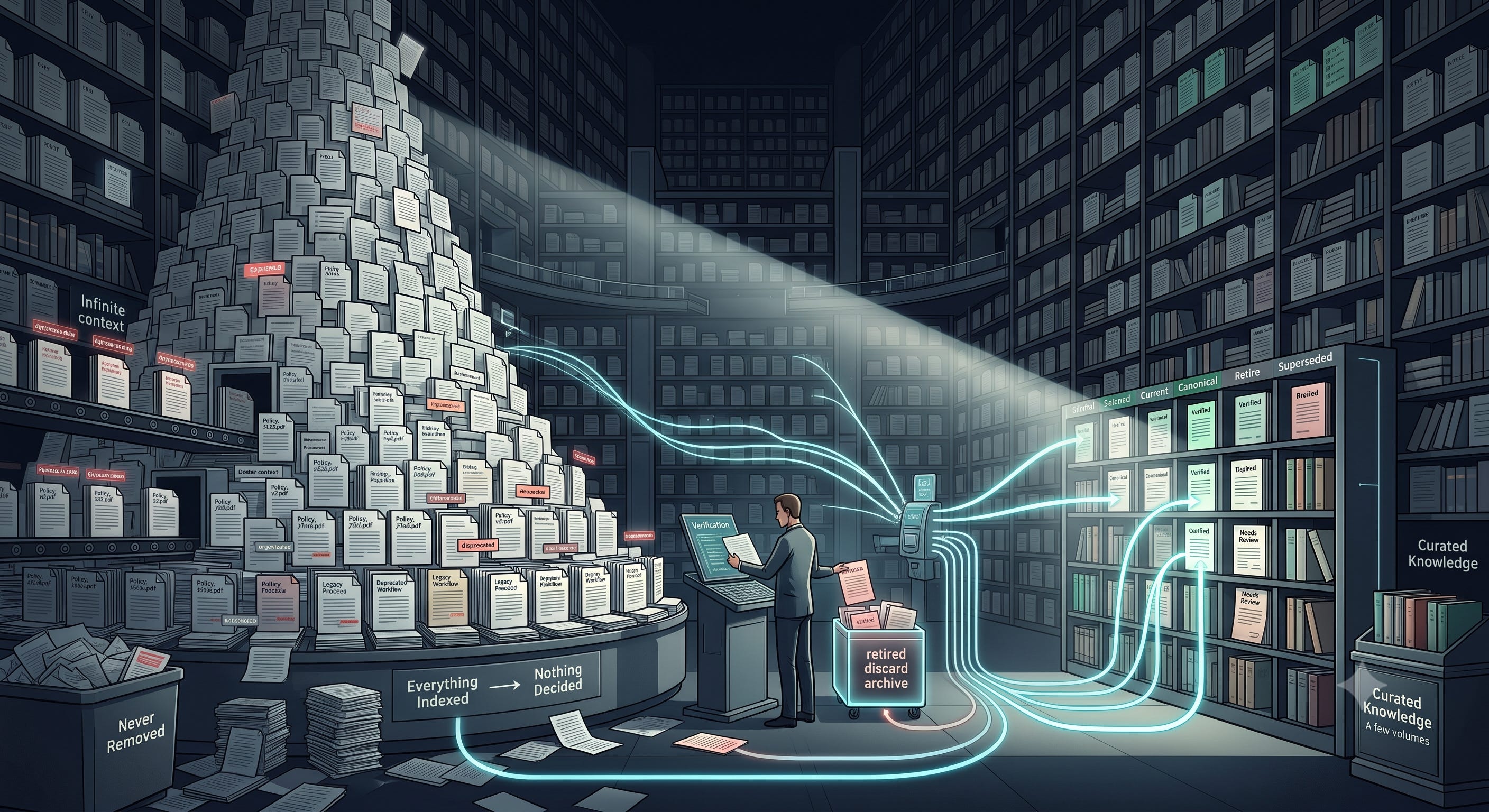
Here’s a prediction that sounded wrong two years ago and reads like a diagnosis now: bigger context windows made AI worse at most companies.
Not technically worse — the models improved. Operationally worse, because million-token windows and cheap retrieval removed the last excuse to make decisions about information. When the window was small, somebody had to choose what went in, and choosing is where the quality lived. Now nothing forces the choice. So the wiki gets embedded, the drive gets indexed, every PDF anyone ever exported gets vectorised — and the organization congratulates itself on having “given the AI our knowledge,” when what it has actually done is bury the signal in a landfill of the true-but-irrelevant, the outdated-but-plausible, and the seventeen drafts of the policy that was superseded in March.
The reason a solo operator’s AI works so well is usually told as a story about context: one head holds the whole business, so the model is always fed the right thing. That’s true, but it misses the sharp edge — and the sharpened version is the whole story: the solo operator isn’t a retrieval system. They’re a relevance system. The asset isn’t knowing everything — it’s knowing what doesn’t matter: which document is stale, which precedent was a one-off, which of the seventeen drafts is real. Retrieval is cheap now. Relevance was never the machine’s job, and it didn’t become the machine’s job when the window got bigger.
Context is judgment about what matters, written down. Which means context is exclusion.
The three ways it fails
Watch organizations wire knowledge into AI and the failures come in three repeatable shapes.
The empty-RAG problem. The retrieval system gets built — often beautifully — and then nobody curates it, because building is a project and curating is a job, and only projects get funded. Knowledge assets rot faster than anyone budgets for: pricing changes, policies supersede, the org chart turns over. Six months in, the system retrieves confidently from a snapshot of a company that no longer exists. The infrastructure was built; the institution wasn’t.
The everything-bagel problem. The opposite instinct — index it all, let retrieval sort it out — fails more subtly. Retrieval returns the closest content, not the correct content, and when the corpus contains six near-duplicate answers of varying vintage, closest is a coin flip weighted by word choice. Practitioners keep rediscovering the same result: a small, curated corpus beats a large, raw one, not occasionally but routinely. More context is not more knowledge. Past a threshold, it’s noise wearing knowledge’s file format.
The ownership vacuum. Ask who owns the knowledge assets and you’ll get a team name, which means nobody. Documentation was already famously nobody’s job; curation — which includes the harder act of removing things — is nobody’s job squared. Yet every other information system the company runs has an owner: the CRM has admins, the ledger has accountants, the codebase has maintainers who delete dead code without holding a funeral. Only the knowledge base is expected to tend itself.
What curation-as-infrastructure looks like
The fixes are unglamorous, which is how you know they’re real.
Exclusion decisions, made explicitly. The catalogue matters, but the discard pile matters more: what is not in the corpus, and why. The act of removing a document is a quality event, and it should be as normal as deleting dead code. If nothing has ever been removed from your knowledge base, it isn’t curated — it’s accumulated.
Knowledge with expiry dates. Every operational fact has a half-life — prices, policies, org structure, integration details. Curated assets carry freshness obligations: this document is trusted until date, then it’s re-verified or it’s out. We run our own knowledge this way, and the discipline changed the question from “is this documented?” to “is this documented and still true?” — which turns out to be a very different question.
Context that ships with the task. The central-pile model — one big corpus, every task retrieves from it — maximizes the dilution problem. The alternative that works: per-domain context packs, assembled for a class of work, carrying exactly what that work needs and nothing else. The unit of curation isn’t the library; it’s the reading list.
Provenance on every fact. Where did this claim come from, and when? A corpus without provenance can’t be maintained — you can’t re-verify what you can’t trace, and you can’t discard what you can’t date. (Readers of this series will notice this is the audit-trail argument arriving at the knowledge layer. Everything in the table connects.)
The feedstock you’re throwing away
Here’s the part that makes curation affordable, and almost nobody does it: your review process is generating context patches all day, and they’re being discarded.
Every time a reviewer corrects AI output — fixes the outdated price, swaps the superseded policy, marks the right one of the seventeen drafts — they have just performed an act of curation. They’ve identified, precisely, a place where the corpus misled the system. In most organizations that correction ships with the artifact and dies there. The knowledge base that caused the error never hears about it, so the error is available again tomorrow.
The loop that fixes it is short: corrections flow back as curation candidates — this document misled, retire or fix it. Review stops being a pure cost (I’ve written about that economy) and becomes the maintenance engine for row 1. The organizations that close this loop get compounding context quality for work they were already paying for. The ones that don’t pay for the same corrections forever.
The library test
A library is not a pile of every book. What makes it a library is the catalogue and the discard pile — the judgment applied to the collection, not the collection.
Three questions to test your own:
Who owns your knowledge assets? A name, not a team. If it’s a team, it’s nobody.
When did something last get removed? Accumulation isn’t curation; the discard pile is the tell.
Do reviewer corrections flow anywhere? If not, you’re discarding the cheapest curation signal you’ll ever get.
Most organizations fail all three — and then conclude the model isn’t good enough. The model is fine. It’s reading everything you never decided about.