Nobody Coordinated This
A stranger from a different corner of software independently built the same governance organs I did. When two lineages that never met grow the same structure, you've found a law, not a fashion.
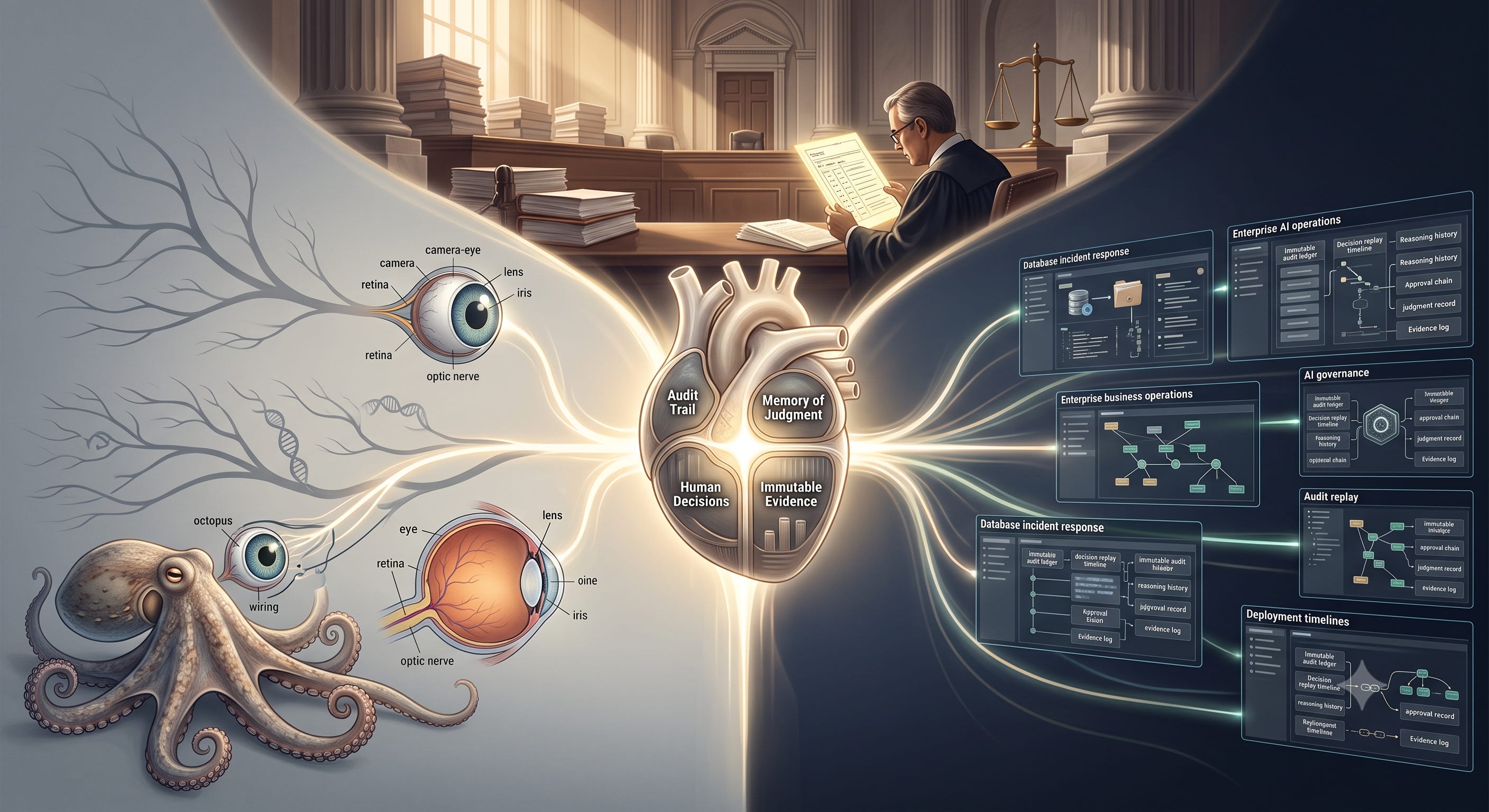
The octopus eye and your eye were invented twice.
Our last common ancestor with the octopus was a flattened worm-like creature some 600 million years ago, and it could not see — at best it had a patch of light-sensitive cells. Everything that makes an eye an eye came afterward, separately, down two lineages that never rejoined: the lens, the iris, the retina, the whole camera. Cephalopods built one. Vertebrates built the other. Neither copied the other, because there was nothing to copy.
And yet they landed on almost the same machine. A lens focusing light onto a dense sheet of photoreceptors, a variable aperture, a focusing mechanism. So close that the giveaway is a defect: the vertebrate retina is wired backwards, its nerves running in front of the sensors, which is why you have a blind spot. The octopus retina faces the right way and has none. Same solution, two independent builds, and the seams prove they were independent.
Biologists have a name for this — convergent evolution — and a rule that goes with it. When two lineages that never coordinated arrive at the same structure, that structure is not a fashion or an accident. It is the answer the environment was forcing. A lens is not one clever idea about seeing. A lens is what seeing demands of anything that attempts it in a world made of light.
I have spent the last month watching this happen in software, in my own inbox, in real time.
Two builders who never met
I build governed AI for business operations. Content that has to be right, customer messages that carry a company’s name, work that runs while the operator sleeps. My whole discipline is the machinery that lets an autonomous system act without the business losing the thread of what it did and why.
A few weeks ago a stranger followed me on LinkedIn: Boris Dali, an ex-Google staff engineer who left to build AI for database incident response. His domain is nothing like mine. He is diagnosing connection-pool saturation on a Postgres cluster at three in the morning; I am running a marketing department. We share no employer, no codebase, no framework, no conversation older than a month. By every measure that usually explains why two products look alike, we are unrelated lineages.
We started comparing notes. And the notes were the same notes.
The same organs, grown separately
Read what each of us had already published, before we ever spoke, and the convergence is uncanny.
The audit trail is the product, not a feature. Both of us had independently concluded that the record of what the system did is not paperwork bolted on for compliance — it is the load-bearing part, the thing the customer is actually buying. In his world it is an incident record; in mine it is an operations record. Same organ.
A log of actions is not enough; you need a memory of judgment. This is the one that stopped me. In his report-card essay, Boris draws a line between two kinds of audit: the what (the receipts — which commands ran) and the why (the reasoning — the hypotheses considered, the alternatives rejected, the confidence, the consent). His sentence: “the WHY turns the audit trail into institutional memory. Without it, every incident starts from zero.” I had published a piece a week earlier arguing that every open-source AI-memory system remembers what is true about the world and none remembers whether the agent’s own past judgment was good enough to be trusted again. Different words, different domain, exact same conclusion: the memory that matters is a memory of judgment, not just of facts.
Certify the harness, not the model. He certifies the playbook that drives the diagnosis, not the language model underneath it, because the model is swappable and the discipline is where the guarantee lives. I had arrived at the identical stance from the business side: the governance wraps the work, and the provider underneath is a commodity you should be able to change without losing your assurances.
Consistency is not correctness. We had both, separately, written down the same uncomfortable truth: a system can be reliably, repeatably wrong, and measuring that it repeats tells you nothing about whether it is right. Two people do not independently phrase that particular caution unless the problem itself keeps handing it to them.
Four organs. Two lineages. No coordination. By the rule of convergent evolution, that is not four good ideas we happened to share. That is the shape the environment is forcing on anyone who tries to operate autonomous AI where the consequences are real.
What the environment is
So name the environment, because that is the whole point. The pressure that grew these organs in both of us is a single condition: an autonomous system takes actions with real consequences, and sooner or later someone asks “why did it do that — and can you prove it?”
Everything else follows from that one sentence. If the consequences are real, you need a record (the audit trail is the product). If someone will ask why, the record has to hold reasoning, not just receipts (the memory of judgment). If you will swap models as they improve, the guarantee cannot live in the model (certify the harness). And if plausible-sounding output can still be wrong, repetition cannot be your proof of quality (consistency is not correctness). A worm in a lit ocean grows a lens. An operator of consequential agents grows an audit trail with a memory of judgment. Same inevitability.
The third lineage showed up this week
Here is what turned a two-point line into a law for me. This week a third, entirely independent lineage published its own version of the same structure — and it was not a builder at all.
The UK Jurisdiction Taskforce, a body of senior barristers chaired by the Master of the Rolls, released a 130-page statement on who is liable when AI causes harm. It is a reading of England and Wales private law — persuasive elsewhere, binding only there, and an analysis of existing law rather than new legislation, so hold the jurisdiction lightly. But strip the legal vocabulary and its core finding is the same organ we grew: liability for an autonomous system, it says, turns on the degree of supervision that was exercised — or should have been — over it. Which is to say the law, too, has concluded that the load-bearing structure is a provable record of the judgment you applied.
Three lineages now. An infrastructure engineer diagnosing databases. An operator running business functions. And a judiciary that has never seen either of our systems. None of us coordinated. All three converged on: the record of judgment is the organ that bears the weight. When the biologists find the same eye in three unrelated animals, they stop calling it a coincidence and start calling it an adaptation to light.
What convergence does and doesn’t prove
One honesty, because convergent evolution is precise about its own limits. It proves the pressure is real. It does not prove either builder has the right answer. The octopus eye and the vertebrate eye both work, and both carry quirks — a blind spot here, a different trade-off there. Convergence certifies that seeing is a genuine problem with a genuine shape; it does not crown a winner. Boris and I will build these organs differently, and at least one of us is wrong about the details in ways we can’t yet see. What we are not wrong about is that the organs are mandatory. That part the environment has already decided.
Which is the actual takeaway for anyone evaluating this category, and it is not a sales line — it is a field-guide entry. If you are looking at agent infrastructure and it has no memory of its own judgment, no record it can prove, no way to swap the model without losing its assurances, you are not looking at an early version of the thing. You are looking at a lineage that has not met the environment yet. It will grow these organs or it will be selected against, because the pressure that produced them in a database engineer, an operations founder, and a room full of barristers is not going to make an exception for your vendor.
Nobody coordinated any of this. That is exactly why you should trust it.