"And once you confirm, it also goes ahead and takes those actions on your behalf."
That is Ajay Prakash, a senior staff engineer at LinkedIn, describing an on-call agent in a talk posted to the AI Engineer channel on September 9. An alert fires. The agent reads the logs, finds the root cause, works out the mitigation steps, and summarizes them for the engineer. The engineer confirms. The agent takes the actions, updates the incident system, and opens a pull request to fix the root cause. Minutes, he says, for work that used to take hours.
The interesting part of the talk is not the agent. It is what the agent runs on.
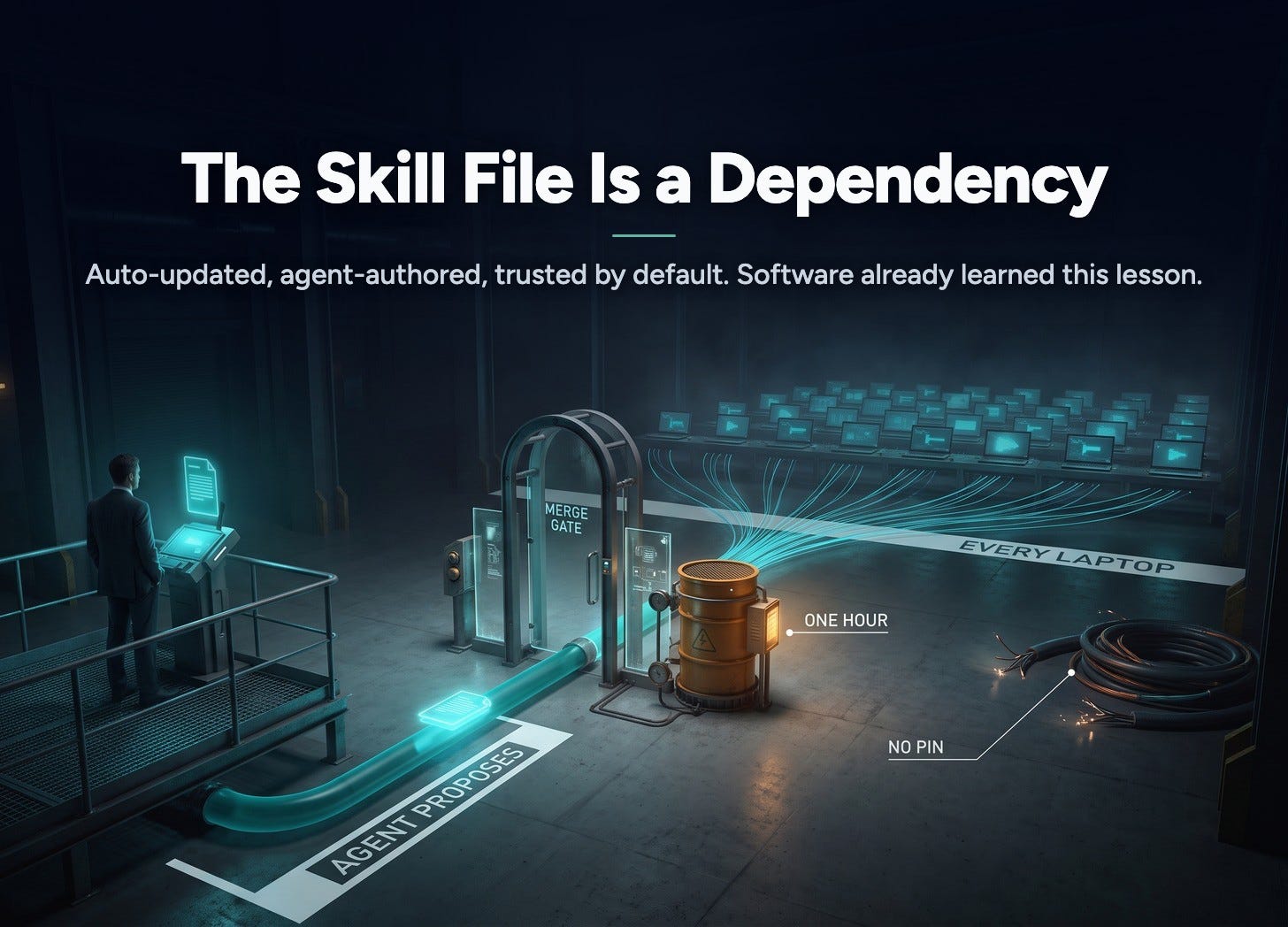
LinkedIn built a system it calls playbooks: instructions and organizational context, served to coding agents through a single local MCP server, where each playbook "just appears just like any other regular tool." Anyone at LinkedIn can write one, check it into a repository, and make it available to everyone else. The server is installed by default on every LinkedIn laptop, and any update to the server, the tools or the playbooks reaches all of those laptops within the hour. By the end of the talk the numbers are over 8,000 daily users, over 1,300 tools and over 600 playbooks. (The talk's title says 500 skills. The speaker says 600. I'm using his number.) The users are not only engineers: he names product managers, designers and TPMs.
Then the part that matters most for this essay. At the end of a session, agents are encouraged to look back at the playbooks they used, find "any outdated information or any discrepancy or any missing information," update the playbook, and create a PR.
I want to be clear about what I think of this before I pull at it. It is good engineering. It solves a real problem he describes plainly: engineers were prompting agents by hand, it took longer than writing the code, and "a lot of engineers went back to manual coding." Playbooks fixed that. The self-improvement loop keeps a knowledge base from going stale, which is the thing every knowledge base does. And routing agent edits through a pull request is exactly the right instinct. The agent proposes; the change lands in a place where review can happen. Prakash closes by saying the system worked because the team "thought about quality and reliability from day one." I believe him.
My argument is not that LinkedIn is doing something wrong. It is that what they have built has a name, and the name comes with a checklist.
It is not a folder of prompts
The usual way to describe skills, playbooks and agent instruction files is "prompts in a folder." At one person's scale that is accurate. At LinkedIn's scale it describes something else.
Count the properties. Many authors, across functions. A central distribution channel. Automatic updates to every consumer within the hour. Consumers that load whichever version is current at the moment they need it. And some of the authors are not people: they are the agents that consume the thing, proposing changes based on what one session learned.
That is a package registry with auto-update and agent committers. Software has run exactly this shape for decades, and it learned, one expensive incident at a time, what a dependency needs before you let it into production. I'm not suggesting anything bad has happened at LinkedIn. I have no evidence of that and the talk gives no reason to expect it. I am saying that "prompts in a folder" puts the thing in the wrong category, and the category decides which controls anyone thinks to ask for.
And what a playbook carries is not configuration. It carries how the company does things: which steps mitigate an incident, how a pipeline gets set up, what the right query is. A playbook is organizational judgment in a form a machine will execute. Once agents can edit it, a change to the playbook is a change to how the company decides, shipped to everyone within the hour.
Four practitioners, four weeks
Prakash is not the only one describing this. Between late August and mid-September, three other named practitioners gave talks that each supply a piece of the checklist.
Imad Touil, a distinguished engineer at QuantumBlack, McKinsey's AI arm, gave a talk in late August titled "AI-Native Organisations Run on Skills." His warning is direct: "if we don't govern skills, we will start creating a new class of technical debt." He lists the forms it takes. Teams on the same stack rebuild the same skills. Quality decays unless you keep validating a skill "not against your task but also against the latest models." And ownership: "if you don't have an owner then no one will be able to maintain" them. On security he makes a general point about public skills: some can contain prompt injection, skills can carry scripts, and without a pipeline that checks them "you may be pulling something that is insecure." His proposed fix is a central platform with a catalog, dependencies, versioning and lifecycle, access control, and evaluation. And then the line I keep coming back to: once you have all of that, you still have to decide who governs it, and "this is where technology stop[s] solving the problem."
I owe a correction here, and it is my own. My research notes from August summarized Touil as saying that pulling a public skill without a checking pipeline "is a supply chain decision." When I went back to the transcript to quote him for this essay, that phrase was not there. What he said is the sentence above, about pulling something insecure. The words "supply chain" are mine, not his. The frame of this essay is my reading of his talk and Prakash's together, and I'd rather you know which parts are whose.
Ignacio Martinez, a developer advocate at Oracle, ran a workshop in September on agent memory. In one segment he describes skill promotion: take a skill that has been used, "promote it through a distillation process and create a better skill.md than the original. So we will retire the old version and update from the new version." It's a good idea, and it contains the one control that nearly every skill system I've seen lacks: retirement.
Laurie Voss of Arize, who co-founded npm and so knows something about package registries, reran a benchmark on how many instructions a model can follow at once. A year ago frontier models fell apart around 200 to 300. Now the boundary is closer to 2,000, and up to 5,000 for the best. "In about 12 months frontier models got close to 10 times better at following instructions simultaneously." But the models "hit the wall at wildly different points," each fails in its own characteristic way, and "capacity went up but reliability is still a problem." His closing advice: "go back and check the assumptions that you made six months ago."
Put those next to each other and the implication is plain. A skill is not only a text file. It is a text file plus the model that interprets it. When the model changes, the skill's behaviour changes, whether or not anyone edited a word.
What a dependency gets that a skill doesn't
Here is the checklist. None of it is new. It is what any engineering organization already requires before a third-party library goes into production, applied to the files that now carry the judgment.
An owner. A named person who answers for the skill: who approves changes, who gets asked when it misbehaves. Touil's point exactly. In a registry of 600, "the team" is not an owner.
A version the consumer chose. Code dependencies are pinned. You upgrade deliberately, you can see what changed, and you can roll back. An hourly auto-update to every consumer is the opposite design, and there are good reasons to choose it: freshness is the whole point of the self-improving loop. But then you have given up the pin, and the other controls have to carry more weight.
A review bar that is written down. This is the crux, and it is where the PR, the right instinct, meets its limit. When a reviewer approves a code change, tests run against it. When a reviewer approves a playbook change, what runs? The diff is prose. It reads well, because the thing that wrote it is very good at prose that reads well. A lesson one agent drew from one session is about to become the instruction for everyone's sessions. The review question is not "is this sentence true?" It is "what behaviour does this change, for whom, and how would we know?" Prakash's talk does not describe how LinkedIn's reviewers answer that, and I won't guess. I'd only say that if the answer is "a person reads the diff," that is a real control, and it is the same control code review was before anyone wrote a test.
A re-test when the runtime changes. For a skill, the runtime is the model. Voss and Touil are saying the same thing from two directions: a skill validated on last quarter's model is untested on this quarter's. The model upgrade is the dependency upgrade nobody files a ticket for. Every skill that matters needs a small eval that runs when the model changes, not just when the text does.
Retirement. Martinez retires the old skill.md when he promotes a new one. Most systems only ever add. A stale skill doesn't sit harmlessly in a folder: with search-based discovery, an agent can find it, trust it and run it long after anyone remembers it exists. A registry with no deletions isn't complete. It is accumulating.
Where I sit
I should say plainly where I sit. I'm the founder of JieGou. We run marketing and operations work for mid-market companies, with agents doing much of the labor, and our own operation runs on the same kind of files this essay is about. An essay arguing that skills need governance is convenient for someone in my business, and you should weigh it that way. So here is our own grade on the checklist, measured this morning rather than remembered.
We have 49 skills. Every change to one goes through a branch and a pull request. Since August 12, 103 commits have touched our skills directory, and 93 of them carry an AI co-author line: agents write most of the changes, and a person merges them. Two checks run automatically on any commit that touches a skill: one confirms each generated skill file still matches its template, and eight static checks confirm that certain skills still contain the refusal branches and guardrails they exist to enforce. Both checks sit in the part of our repository that agents are mechanically blocked from changing, because the files that are the gate should not be editable by the thing they gate. That part holds up.
Now the part that doesn't. Behavioural tests, where a model is actually run against a case the skill must refuse and one it must accept, exist for three of the 49. They are run by hand, because they cost money. The last passing runs I can find a record of are from August 12, and the fact that I had to go looking is itself a gap: nothing logs them. This week the model our agents run on changed version. On September 24, two of those three tested skills were edited. The static checks passed. Nobody re-ran the behavioural tests against the new model. I don't think anything broke, since the edits were to a reporting step rather than the decision, but "I don't think" is exactly the answer this essay says isn't good enough. By the fifth control we fail outright: in the sixteen weeks we have been writing skills, we have never retired one. Not a single skill has been deleted. And our owner control passes only because there is one founder, which is a fact about headcount, not a design.
So our grade: a review gate, yes, and the gate itself protected. Versions, yes, in the sense that git has them, not in the sense of a pin. A re-test when the runtime changes: no. Retirement: no. The two we fail are the two that only matter over time, which is why they are easy to skip.
The checklist, for your own files
If your company runs agents on shared skills, playbooks, rules files or instruction files, five questions will tell you whether you are treating them like the dependencies they are.
For each skill, whose name is on it? Not the team that wrote it. The person who approves changes.
Can a consumer tell which version it ran? If an agent took an action yesterday, can you say which text of which skill it was following when it did?
What does a reviewer check on an agent-authored change? Is it written down, and does anything execute, or is it a person reading prose?
What runs when the model changes? If the answer is nothing, every model upgrade is an unreviewed change to every skill.
When did you last delete one?
None of this asks you to slow the loop down. LinkedIn's loop is the right idea: agents noticing where the instructions are wrong and proposing a fix is how a knowledge base stays alive. The loop is fine. The question is what the merge checks.
Software already went through this. It spent a decade learning that the code you didn't write, updated automatically and trusted by default, was where the risk sat, and it built owners, pins, reviews, tests and deprecation around it. The files that carry your company's judgment now have the same shape. They should get the same controls.
Sources (all public; transcripts read from the official AI Engineer talk pages, 2026-09-25):
Ajay Prakash (LinkedIn), "500 Skills, Zero Fine-Tuning: LinkedIn's Playbook for AI Agents" (2026-09-09): https://www.youtube.com/watch?v=9wZpvF3QleU · transcript https://ai.engineer/talks/9wZpvF3QleU-500-skills-zero-fine-tuning-linkedins-playbook
Imad Touil (QuantumBlack), "AI-Native Organisations Run on Skills: How to Structure and Scale Them": https://www.youtube.com/watch?v=M05vON8i0aI · transcript https://ai.engineer/talks/M05vON8i0aI-youtube-c037f48b40a730bc536e
Ignacio Martinez (Oracle), "Total Recall: Agent Memory and Harness Engineering" (2026-09-18): https://www.youtube.com/watch?v=xs-ob87TTzg · transcript https://ai.engineer/talks/xs-ob87TTzg-total-recall-agent-memory-harness-engineering
Laurie Voss (Arize AI), "How long can your skills be before your agent forgets what you told it?" (2026-09-09): https://www.youtube.com/watch?v=XzJD1bvXKjs · transcript https://ai.engineer/talks/XzJD1bvXKjs-long-your-skills-be-before-your-agent