"Self-Sufficient When We Leave" Has a Floor
AWS just put a billion dollars behind forward-deployed AI. Its own model names exactly who it cannot serve.
On 30 June 2026 AWS announced a dedicated Forward Deployed Engineering organization backed by a one-billion-dollar investment. It is the fourth structural bet on the same delivery shape in two months. In May, Anthropic put more than 1.5 billion dollars into a joint venture with Blackstone, Hellman & Friedman, and Goldman Sachs. OpenAI launched a Deployment Company with four billion dollars and more. KPMG announced a global alliance with Anthropic. Those were the model layer and the consulting layer. AWS is the infrastructure layer, and it made the bet first-party rather than through a funded joint venture.
The pattern is no longer ambiguous. The durable value in enterprise AI is not the model. It is the embedded, governed, agentic delivery that turns a model into a production system inside a specific company. The whole stack now agrees.
I have been writing that this embedded model has a structural ceiling, and that the ceiling is where most of the market lives. AWS’s own announcement draws the line more clearly than I could.
Two of its three pillars are arguments I just made
AWS describes its model in three properties: agentic-first, timelines compressed from months to days, and customers left self-sufficient when a deployment ends. Two of the three are positions I argued in the last fortnight, and the overlap is worth stating plainly, because the agreement is the point.
The first. AWS says its agents accelerate every phase while human engineers verify and guide. That is the governed-AI position exactly. The machine executes and a human keeps the judgement. Last week I argued that “do not let AI render the verdict” has to be built into how a system works rather than left to a user’s willpower. AWS has now funded the same principle as a delivery standard at a billion dollars. The band where AI is safe is the band a human verifies, and AWS is staffing it with people whose job is to verify.
The second. AWS deploys what it calls a governed, versioned knowledge graph into the customer’s own account, so that, in its words, “domain expertise lives in the customer’s code, not in institutional knowledge that could rotate off.” It adds that it delivers “through customers’ agents and systems, not just through people who may leave.” That is the operating-memory argument almost word for word. The asset is not the model and not the engineer. It is the accumulated, governed memory of how this specific operation runs, captured so it outlives the people who built it.
When the largest cloud provider funds your thesis at a billion dollars, the thesis stops being the question. The question becomes what the funded version cannot do.
The floor inside “self-sufficient when we leave”
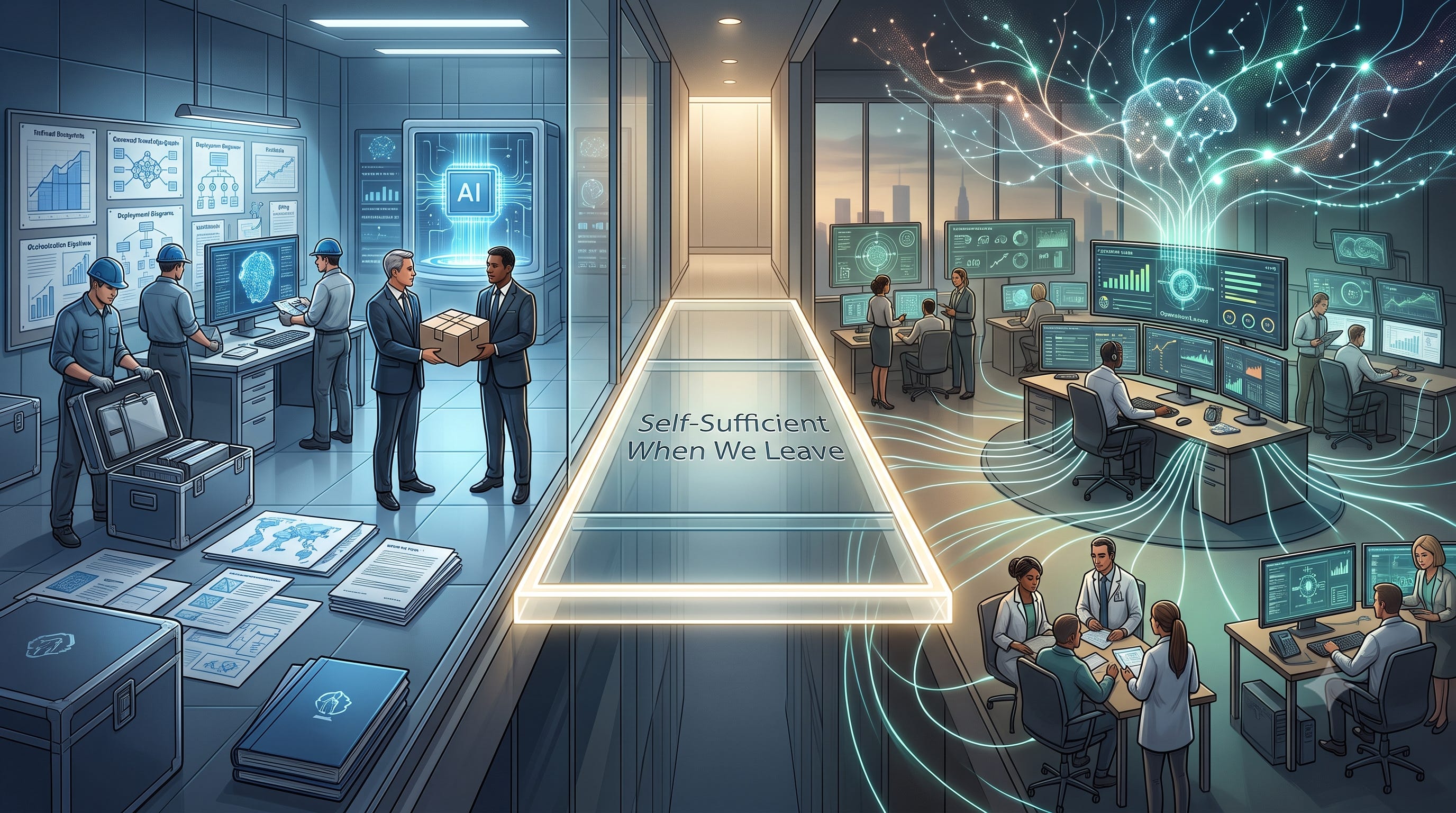
The third property is the one to read slowly. Customers are self-sufficient when a deployment ends. Engineers move, in AWS’s words, “from observers to co-builders to autonomous operators.” The customer keeps the systems, the runbooks, the knowledge graph, and the trained internal champions, and runs all of it alone.
That is a real and good model, and it has a floor. “Self-sufficient when we leave” assumes a customer who can become self-sufficient. Read who AWS names: the NFL, Southwest Airlines, Cox Automotive, the NBA, the Allen Institute, Ricoh. Each is an organisation with an engineering team that can graduate into autonomous operators. The model is built for them, and it is excellent for them.
Now move down the revenue curve to the businesses that are not engineering organisations at all. A regional dental group. A behavioural-health platform with forty clinics. The small firms a managed-service provider keeps running. None has an engineering bench waiting to become autonomous operators of an agentic system. For them, “we build it and leave you self-sufficient” resolves to a harder sentence: we leave you a system you cannot run. The handoff that is the entire point of the model is the moment it fails them.
This is the same line Anthropic drew in May, when its own positioning said the less regulated and smaller accounts are “served by partner networks and self-serve API tooling instead.” The vendors are consistent and honest about it. The embedded, build-and-exit model serves the top of the market, where the deal size carries the engineer and the customer can operate what is left behind. Below that line the model does not reach, by its own design. The new thing AWS adds is that the limit is not only economic. It is a capability floor. The model requires a customer who can take the keys.
Who operates for everyone below the floor
The half of the market under that floor does not need someone to build a system and leave. It needs someone to operate the system on its behalf, continuously, under governance it can trust. That is a different shape. The vendors fund forward-deployed engineering, which builds and exits. The shape below the floor is forward-deployed operations, which runs and stays.
That distinction is the whole game. AWS validated who builds the system embedded inside the customer. It did not, and structurally cannot, serve who operates the system for the customer who will never staff it. Building is a project, and projects end. Operating is a relationship, and it does not. The moat was never who builds. It is who operates.
The memory the model cannot pool
There is a second thing the build-and-exit model cannot do, and it sits inside the part AWS got right. AWS says each customer project compounds intelligence for that customer’s next project. That is true, and valuable, and bounded. The knowledge graph lives in the customer’s own account, and when the engagement ends, AWS leaves. The compounding stops at the edge of one customer.
An operator who runs many books has no such edge. The governed, de-identified memory of how one dental group handles a recall makes the next dental group’s recall better. The fiftieth client is faster because the first forty-nine taught the operation, and the operator carries that learning across all of them. A model that deploys an isolated graph into each account and then departs cannot pool across customers. It is the wrong architecture for the network effect, by construction, because copying it would mean never leaving. The operator’s cross-client memory is the one moat the embedded-engineer model cannot reach.
The category is settled; the floor is the opening
So read the AWS announcement as what it is. It is the strongest available confirmation that managed, governed, agentic delivery is the durable layer above the model, and an unusually clear statement of where that delivery stops. It stops at the floor of self-sufficiency, and at the edge of one customer’s account.
I should declare the bias. Operating that system for the businesses below the floor, with the governance and the cross-client memory the build-and-exit model cannot offer, is what I do. So of course I read the line where the vendors stop as the line where the work begins.
The category is no longer in doubt. A billion dollars from AWS, on top of everything from May, settled that. The only question left is the one the funded model answers by walking away. Who operates it for everyone who cannot operate it themselves.